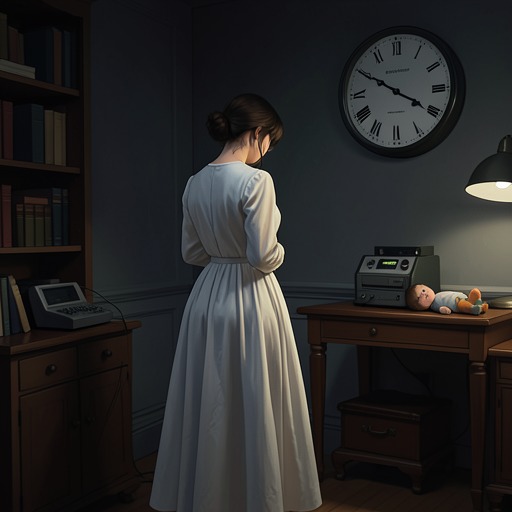
Louise Misses Her Abortion Appointment
Chanson douceLouise Misses Her Abortion Appointment is a decisive episode in Louise’s life: at twenty-five, pregnant and working in the home of M. Franck, she fails to wake on the day of a scheduled abortion and does not go to the procedure. She keeps the pregnancy, gives birth to Stéphanie, and leaves the job. The episode brings together intimate bodily change, an employer’s power over a worker’s choices, and the consequences that endure long after the appointment itself.
Background and Circumstances
At the time, Louise cared for Geneviève, the elderly mother of M. Franck, a painter living in a townhouse in Paris’s fourteenth arrondissement. Geneviève had fractured her hip, lost the ability to walk, and become profoundly disoriented. She spent most of her time naked in a ground-floor bedroom because dressing her provoked violent resistance. M. Franck had first hired expensive, qualified nurses, but he judged them cold and rough; he wanted someone who could care for his mother with tenderness and listen to her delusions.
Louise had impressed him with her physical strength and patience. On her first day, she lifted and washed Geneviève by herself, speaking to her until the older woman stopped screaming. Louise later slept beside the medical bed, washed her, and endured her nighttime terror, insults, and attempts to strike her. But the demands took a physical toll: she began sleeping too deeply to hear Geneviève’s cries, and eventually her arms and back could no longer manage the work. It was amid this already exhausting care arrangement that Louise discovered she was pregnant.
At twenty-five, she woke with heavy, painful breasts and felt a new sadness come between her and the world. The narrative presents pregnancy first as a bodily fact and an emotional disturbance, before turning to the social judgment that follows. Louise knew something was wrong with how she felt, but the people around her did not treat the pregnancy as a private decision in which she could simply seek support.
M. Franck’s Response
When Louise told M. Franck, he reacted with anger and ridicule. He called her irresponsible because she was single and barely earning a living, mocked her round eyes and foolish smile, and asked whether she expected him to celebrate. He insisted that she had no sound judgment and should be grateful to have an employer willing to help her. Although he said her private life was none of his concern, he interrogated her about where she had been on Saturday nights, who the father was, what he looked like, and what he intended to do. Louise answered the repeated questions with the same evasive phrase: it was nobody.
His response contained both practical assistance and control. M. Franck said he would take Louise to the doctor and wait for her during the abortion. He also promised that, afterward, he would give her a proper employment contract, pay money into a bank account in her name, and provide paid leave. Those promises would have addressed some of the insecurity of her work, but they were made as part of a plan in which he had already decided what should happen to the pregnancy. The contrast is central to the episode: he could offer concrete protections as an employer while treating Louise’s expected child as an error requiring correction.
The arrangement also exposes the unequal terms of domestic employment. M. Franck entrusted Louise with the care of the person who mattered most to him, depending on her strength, availability, and emotional labor. Yet when her own circumstances changed, he assessed them through her poverty and unmarried status, speaking as if his judgment gave him authority over her future. His offer of formal employment did not erase that imbalance; it sat beside a harsh demand that she accept his view of what a woman in her position should do.
The Missed Appointment and Its Consequences
On the day of the operation, Louise did not wake up and missed the appointment. The account gives no further explanation for why she slept through it, so the event remains starkly unresolved rather than becoming a declared act of defiance. What follows is clear: Stéphanie was born, and Louise did not return to M. Franck’s household. She never saw Geneviève again.
The narration describes Stéphanie’s arrival in visceral terms, as a life taking hold of Louise’s body and altering her youth. That language makes the birth both a consequence of the missed procedure and a transformation that cannot be reduced to M. Franck’s practical calculations. The employer’s proposed sequence—a medical intervention followed by a contract and paid leave—does not take place. Instead, Louise becomes a mother, loses this job, and carries the effects of that change into the life that comes afterward.
Years later, while employed by Myriam and Paul Massé, Louise has a grown daughter, Stéphanie, who is nearly twenty. When the Massés interview her as a prospective nanny, Louise presents her availability and mentions that her husband is dead; she describes Stéphanie as nearly twenty, a detail that makes the earlier pregnancy part of the history behind the apparently composed candidate. The book does not present the missed appointment as the only cause of Louise’s later isolation or circumstances, but it establishes a concrete early rupture: a pregnancy, a failed appointment, a lost job, and a daughter who remains part of her life.
Work, Motherhood, and Unequal Choice
The episode resonates with the Massés’ later search for childcare. Paul prepares a timed interview process and says they need someone lively and available so that the parents can work. His requirements exclude undocumented applicants for childcare, and he distinguishes between domestic jobs where undocumented workers might be acceptable and looking after children, which he considers too risky. Myriam is uneasy about Emma’s advice that a nanny’s children should be left in her home country so she can stay late or babysit, but she avoids confronting Paul because she knows he puts family and career first.
The contrast is not that Louise’s experience and the later candidates’ situations are identical. Rather, the two episodes show how childcare employment makes women’s own family lives a matter of employers’ convenience. M. Franck treats Louise’s pregnancy as incompatible with her precarious work and urges an abortion; the Massés seek a worker whose availability will fit around their careers, while their hiring criteria sort candidates by age, immigration status, language, and perceived suitability. Louise’s history places her on both sides of that pressure: she has been a vulnerable worker whose pregnancy disrupted an employer’s expectations, and she later becomes the hired caregiver whose availability is prized by another household.
The hiring scene also exposes the contradiction between the appearance of a private family decision and the power exercised through employment. The Massés prepare their apartment for interviews, clean and arrange the children’s things, and want candidates to see them as serious, orderly parents. They also recognize themselves as the employers. Louise’s earlier encounter with M. Franck has already shown what that position can mean: an employer may present intervention as help while judging a worker’s intimate life according to the demands of the household.
Narrative Significance
The missed appointment is narrated as a turning point without a reassuring explanation. Louise does not announce a reason, and the account does not convert her failure to wake into a simple declaration of choice. That silence preserves the ambiguity of the event while its consequences remain unmistakable: Stéphanie is born, Louise leaves the household, and Geneviève disappears from her life. The scene’s force comes from the distance between what M. Franck promises—a doctor, a contract, a bank account, paid leave—and the future that actually unfolds.
In the novel’s wider portrait of domestic work, the episode makes visible how care can be both intimate and unequal. Louise is trusted with the naked, distressed body of Geneviève, but her own body and pregnancy are discussed as a problem of responsibility and employment. Later, the Massés’ interview criteria and their desire for a nanny who is fully available repeat the pressure in another form. Louise’s missed appointment therefore matters not only as a private event in her past, but as an early instance of the unequal bargain between the household that hires care and the woman whose own life must accommodate it.